Blog
Map Pack ranking factors — what actually moves the needle
2026-03-04 · by Roger, Kotik Solutions
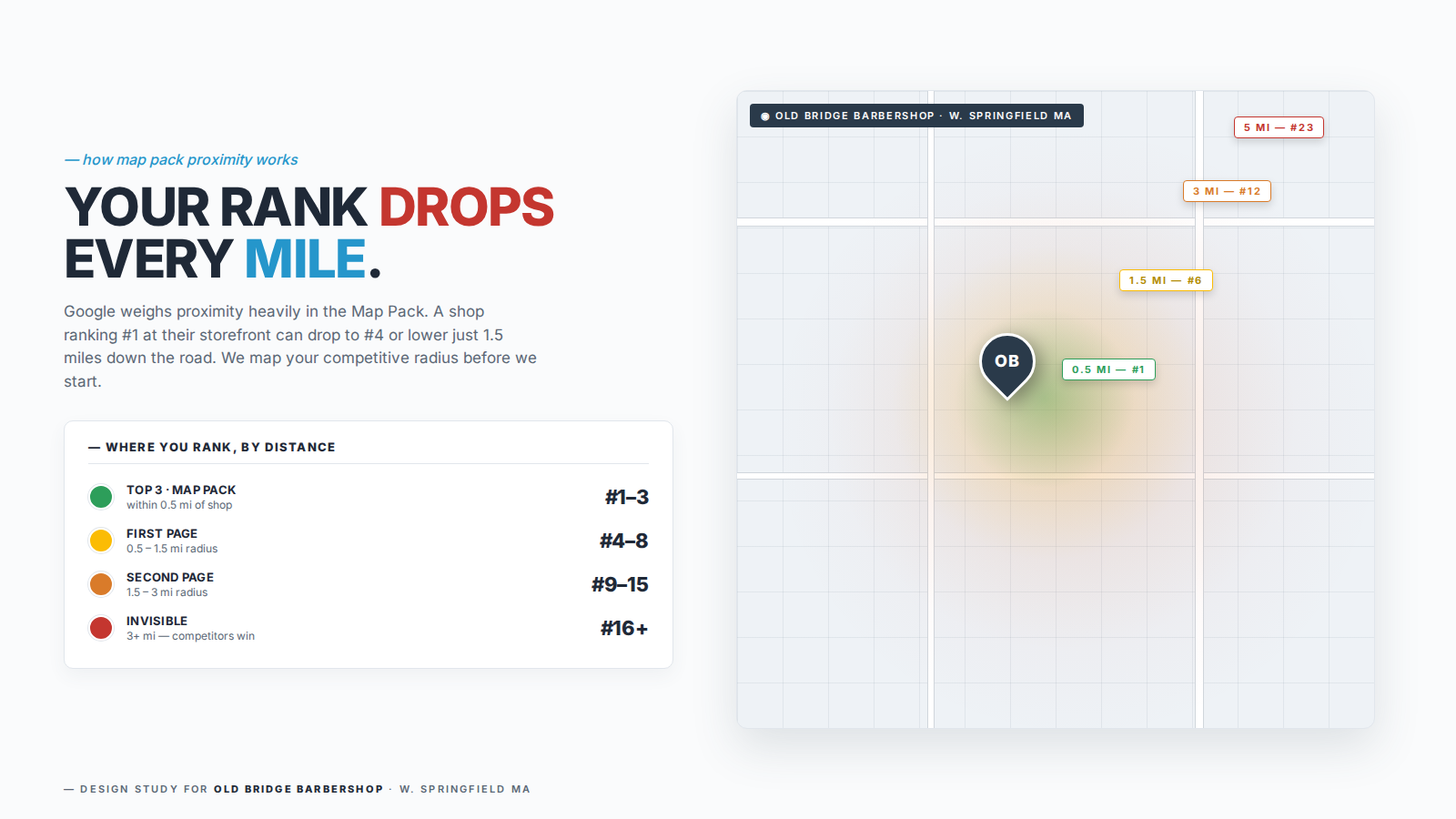
Most local searches never go past the three businesses Google shows at the top — the Map Pack. If you’re not in it for your primary services, you’re invisible to most of the potential customers searching for you.
Here’s what actually decides who shows up.
The top 5 signals, ranked
1. Primary Google Business Profile category
The single biggest factor. Not close. A profile categorized as “Plumber” has a fundamentally different ranking potential than one categorized as “Contractor.”
The fix is one click: pick the most specific, accurate primary category available.
2. Proximity to the searcher
Google heavily weights how close the searching user is to your listed address (for storefronts) or service area (for service-area businesses). This is why Map Pack rankings change as you move around your city — you’re closer to some businesses than others.
You can’t fully control this, but you can make sure your address is correct and your service area is defined accurately.
3. Review signals
In order of impact: response rate > recency > star rating > volume.
- A business responding to every review outranks one that ignores them.
- Ten reviews from the last year beat fifty from four years ago.
- A 4.4-star business with lots of recent activity often outranks a 4.9-star business that’s gone quiet.
- Volume matters, but less than the first three.
4. On-site Local SEO signals
Your website still matters for Map Pack rankings, even though the Pack is GBP-driven. Specifically:
- Location-relevant content on key pages.
- NAP (Name, Address, Phone) matching what’s on your GBP exactly.
- LocalBusiness schema on the homepage.
- Internal links that reinforce topical relevance.
5. Citations and NAP consistency
Being listed, with consistent information, on the major directories (Apple Maps, Bing Places, Yelp, Facebook, BBB, and the major niche directories for your industry). Inconsistent information across these dilutes the signal and confuses Google about whether two listings refer to the same business.
What matters less than you think
- Social media posting frequency. Valuable for other reasons; weak Local SEO signal.
- Blog posts on generic topics. Useful for broader SEO; not a Map Pack driver.
- Paid tools from “local SEO” vendors that promise #1 rankings. There are no shortcuts; if there were, Google would plug them the next day.
- Keyword stuffing your website. Often hurts more than it helps.
Two months vs. two years
The first two months of serious Local SEO work can dramatically improve your visibility — GBP completion, NAP cleanup, and the first reviews compound fast.
Two years in, the gains come from consistency: every month adding reviews, refreshing photos, keeping citations clean, responding to every review. The businesses that compound win. The ones that sprint and stop don’t.
A 90-day plan
- Month 1: Complete GBP. Clean NAP across top 20 directories. Set up review request system.
- Month 2: Add FAQ + schema to site. Publish first two location-relevant pieces of content. Keep review cadence.
- Month 3: Review what moved. Tighten weak spots. Keep going.
By month 6, most small-business clients have moved meaningfully in the Map Pack. By month 12, the compounding is obvious.
Want us to run this for you? That’s what Local SEO does.