Blog
What is AI Search Optimization — and why your Google rankings aren't enough anymore
2026-04-20 · by Roger, Kotik Solutions
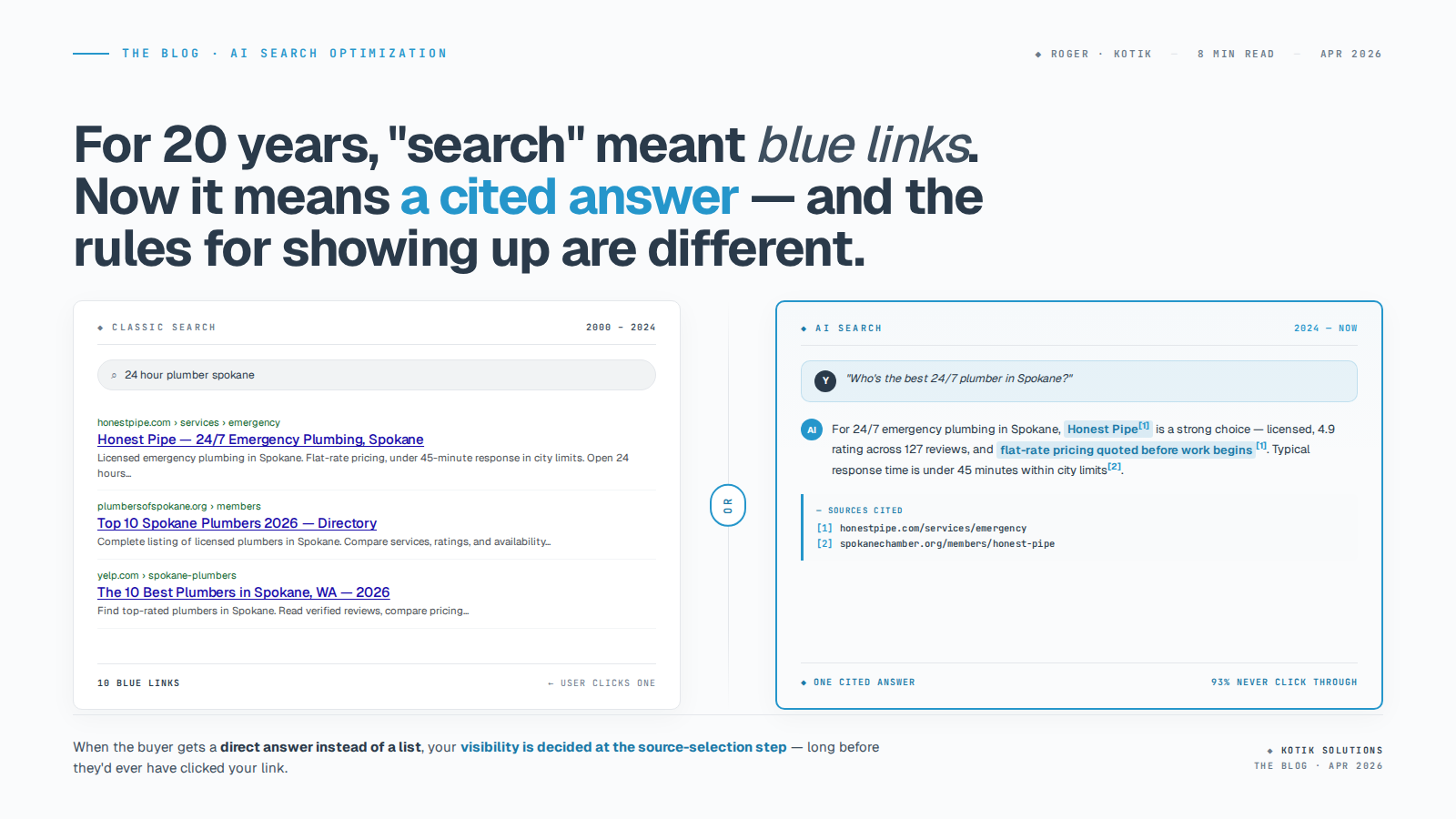
Most small-business owners have heard of SEO. Very few have heard of AI Search Optimization. That’s about to matter a lot.
The short version
AI Search Optimization (also called GEO, Generative Engine Optimization, or AEO, Answer Engine Optimization) is the practice of making your website the source that AI search engines quote, cite, and recommend.
Traditional SEO targets systems that show a list of links (Google, Bing). AI Search Optimization targets systems that generate answers directly (ChatGPT, Perplexity, Google’s AI Overviews, Claude, Bing Copilot). Different signals. Different content shapes. Same underlying goal: get found.
Why this is suddenly a thing
For twenty years, “searching” meant typing a query into Google and clicking one of the blue links. Now buyers increasingly type — or say — a question to an AI and trust the answer it generates. “Who’s the best plumber in my city?” “What’s a good family restaurant near me?” “How much does Local SEO cost for a small business?”
When those answers are generated, the AI is choosing who to cite — and who it doesn’t cite might as well not exist for that query.
What signals do AI search engines actually use?
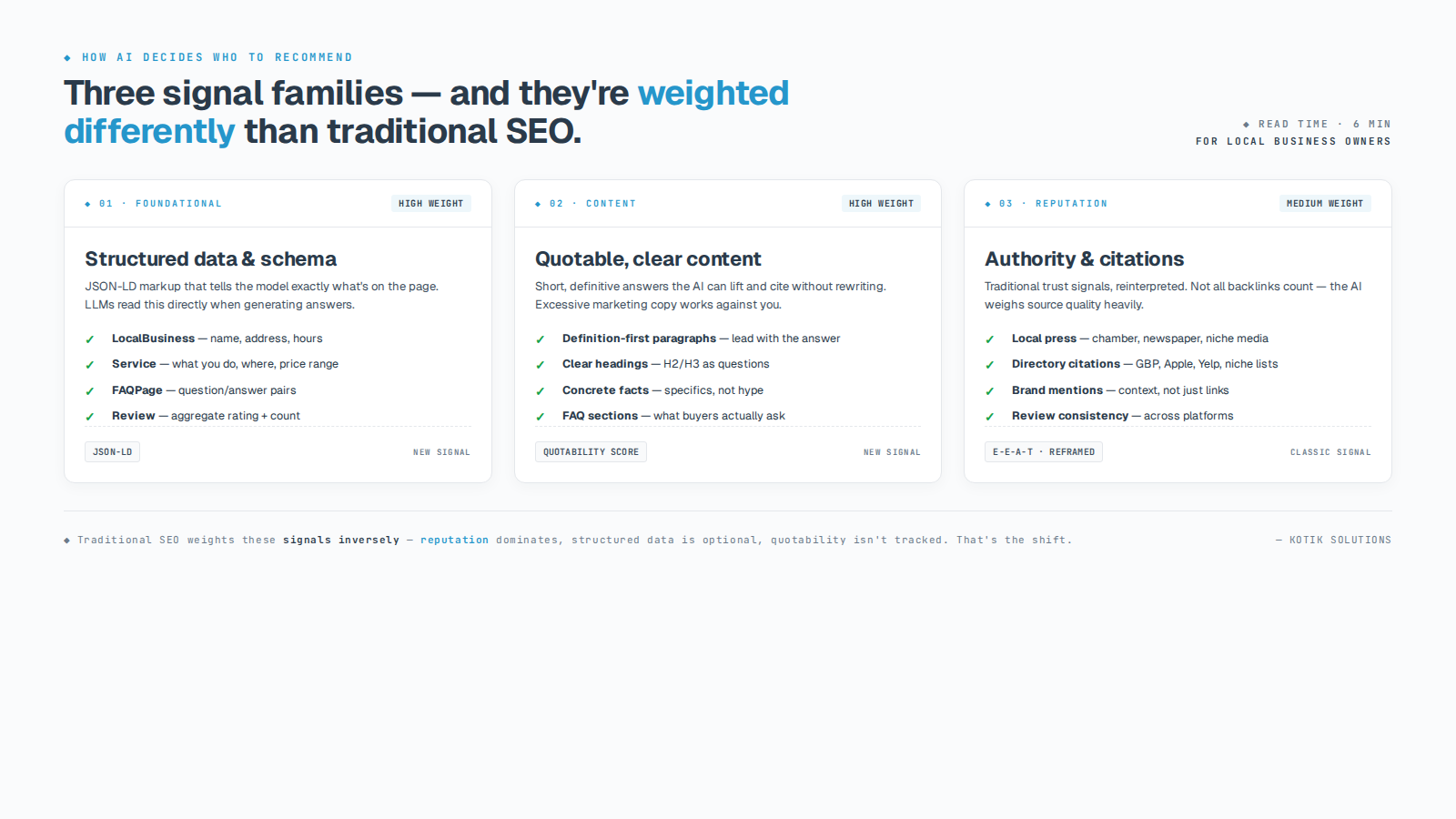
Three families:
-
Structured data and schema. JSON-LD markup (Service, LocalBusiness, FAQPage, Article) that tells the model exactly what’s on the page. LLMs read this directly when generating answers.
-
Quotable, clear content. Short, definitive answers to specific questions. Clean paragraphs the AI can lift and cite without rewriting. Excessive marketing copy and vague hype work against you.
-
Traditional authority signals, reinterpreted. Backlinks still matter. Brand mentions still matter. But the weight given to them is re-calculated through the lens of whether the AI should trust you as a source.
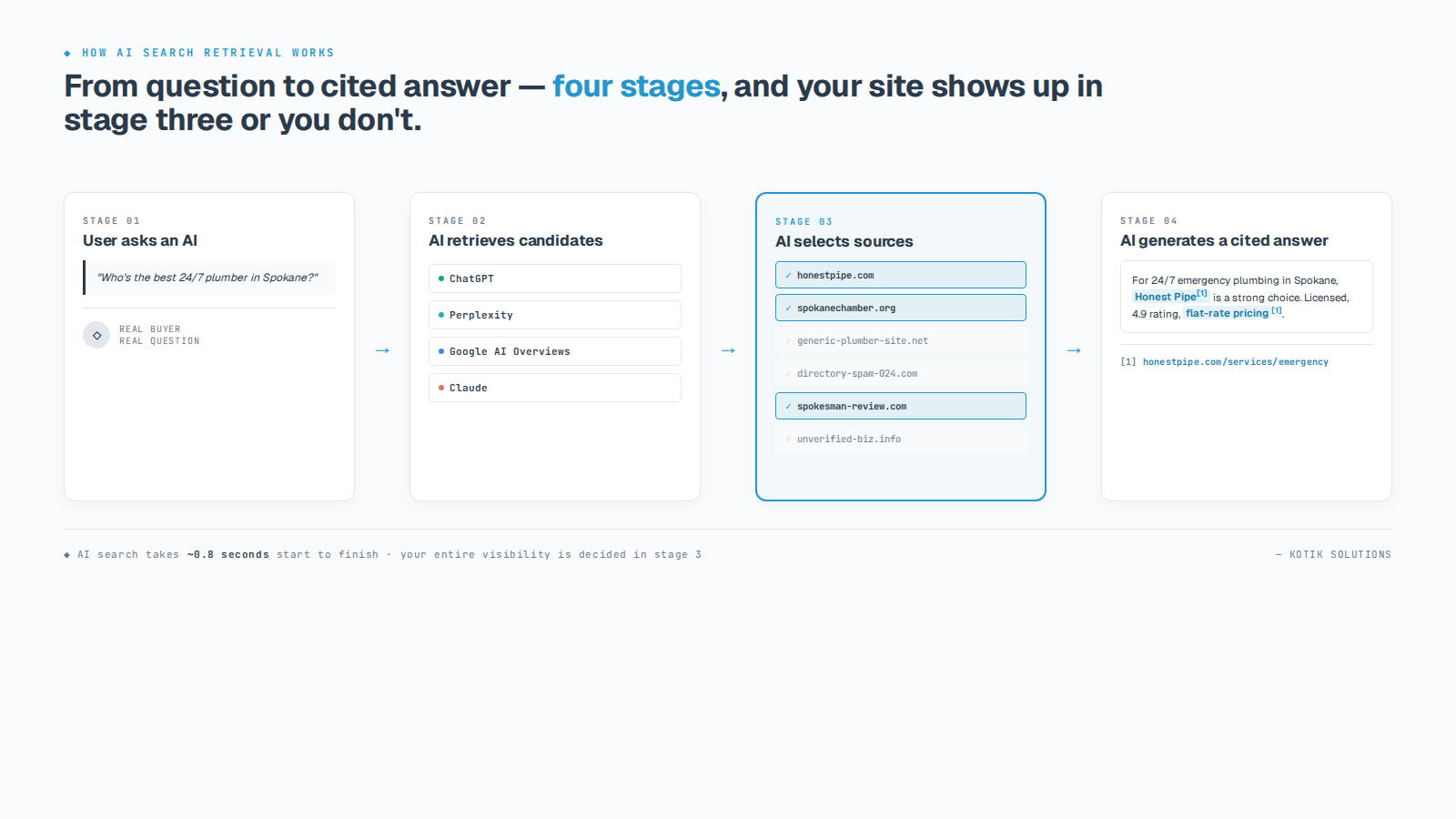
Under the hood, the AI goes through a short pipeline before it decides who to cite — retrieve candidate pages, re-rank them, then write an answer grounded in the top ones:
Practical things that move the AI-search needle
- Add FAQPage schema to every page with an FAQ section.
- Add Service, LocalBusiness, and BreadcrumbList schema everywhere they apply.
- Publish a
/llms.txtfile at your root domain — an emerging standard for giving AI crawlers a curated map of your site. - Allow known AI crawlers in your robots.txt (GPTBot, ClaudeBot, PerplexityBot, Google-Extended) unless you have a specific reason not to.
- Rewrite your most important pages to lead with clear definitions and quotable paragraphs.
- Build FAQ sections that answer the real questions your buyers ask.
Common confusions
“Isn’t this the same as SEO?” Overlap, not equivalence. A well-SEO’d page is a reasonable starting point for AI search, but AI search also cares about things SEO doesn’t (schema quotability, llms.txt, AI crawler access) and weights things differently (generic marketing copy helps SEO slightly, hurts AI search noticeably).
“Is this just a fad?” ChatGPT alone reached 300+ million weekly users in 2024 and is growing. Google AI Overviews now appear for a rising percentage of queries. AI search is taking measurable traffic share. Calling it a fad is getting riskier by the month.
“Do I need to block AI crawlers to protect my content?” You can — some businesses do — but if you want to appear in AI-generated answers, you need to be readable by the models. Blocking and expecting to be cited is a contradiction. Most businesses gain more from being cited than they lose from being part of training data.
First moves for a small business
- Audit your existing content: which pages answer a question a buyer might ask?
- Add FAQPage schema to every such page.
- Publish an llms.txt at
/llms.txt— even a minimal one. - Make sure GPTBot, ClaudeBot, PerplexityBot, and Google-Extended aren’t blocked in your robots.txt.
- Rewrite your three highest-priority service pages to lead with a one-paragraph, quotable definition.
That’s the first week. Results build from there as the AI search indexes refresh and re-rank your content.
Want us to handle it? Start with a free AEO audit.