For nonprofits & community organizations
Growth marketing for nonprofits whose website has to convince a donor and help a neighbor in one visit.
Two people land on a nonprofit's website with almost nothing in common. One is deciding whether to trust an organization with money. The other needs to know whether they qualify, where to go, and what happens next. Most nonprofit sites are built carefully for the first and leave the second to work it out.
What nonprofit marketing has to answer for
The same page is read by people with opposite needs
A donor wants outcomes, financials, and some evidence the money does what you say it does. Someone who needs the service wants eligibility, an address, a phone number, and whether they can come today. A volunteer wants a date and a form. A homepage written in the register of an annual report answers the first and stalls the other two.
Your credibility gets checked by people you never meet
Grantmakers, board candidates, and corporate partners look you up before a conversation rather than after it. A site with a finished event still on the homepage and no annual report anywhere on it reads as an answer about how the organization is run, not about how the site was designed, and that reading is hard to argue with once somebody has formed it.
Every dollar here is a dollar somebody will ask about
Marketing spend at a nonprofit gets scrutinized in a way it is not at a business, and the scrutiny is fair, because it is money that could have gone to the program. That does not make the spend wrong. It does change what a sensible engagement looks like: small, visible, and attached to something a board can see the result of.
There may be search budget you have never claimed
Google Ad Grants gives eligible 501(c)(3) organizations up to $10,000 a month in search advertising. Plenty of organizations never apply, and plenty that did are sitting on an account nobody has opened since it was set up. It is not free money in the sense of being effortless — it comes with its own rules and requirements — but it is budget that does not come out of the program.
What we do
Where a nonprofit budget actually goes
We scope this small and let it earn its next step, rather than handing a nonprofit something that has to be defended at the next board meeting. In practice the free and near-free ground comes first — the listing, the site, the ad grant — before anyone is asked to move money out of a program.
A site that does not make a donor and a beneficiary share a path
Separate routes from the first screen: a give flow that works on a phone, and program pages stating eligibility, location, and the next step in plain language. Built to be accessible, because a site that is hard to use excludes the exact people many nonprofits exist to reach, and because funders increasingly ask about it.
AI Search Optimization
An assistant answering "where can I get help with this in my county" is paraphrasing you, not quoting you. Eligibility written in grant language — service area, income bands, referral requirements — tends to shed its conditions in that retelling, and somebody ends up at the wrong organization or believing they do not qualify when they do. We state those rules plainly enough that they survive being summarized by something that has never met you.
Local SEO & map visibility
Google Business Profile, hours, service area, and consistency across the directories people get referred through — including 211 and community-resource listings a caseworker or a discharge planner is reading from. Wrong information in one of those sends someone to the wrong door on the day they needed the right one.
Paid Search, starting with the Ad Grant
The application, or the rescue of a dormant account, comes first — then campaigns built inside the grant's constraints: search only, a default bid ceiling that keeps you out of the most competitive auctions until the account is set up to get past it, and account requirements that can get the grant account deactivated if they go unmet. Paid dollars come afterward, and only for the searches the grant cannot reach.
Paid Social for donors, volunteers, and events
Meta campaigns for the asks that respond to them — a fundraiser, a volunteer call, an event with a date on it — run to a radius that matches where your supporters live. Advocacy and social-issue messaging falls into Meta's restricted category, where targeting options are narrower than for commercial ads, which is worth knowing before a campaign is planned around targeting it cannot use. This is paid media only; if a volunteer runs your Facebook page, they keep it.
Conversion & Analytics
Donations, volunteer sign-ups, and program inquiries tracked as three separate things, because they are, and reported in a form that goes into a board packet without translation. The Ad Grant requires valid conversion tracking of its own, so this is not administrative overhead — it is a condition of keeping the account.
For a business this size that usually means Local Presence — from $500 per month, with the site, the listing, and the local search work in one number; the paid search and paid social above are scoped separately. Prefer to own it outright? Local Build + AI is a one-time project, from $2,500. Compare both.
Proof
Built for a Jonesboro nonprofit recruiting its first cohort
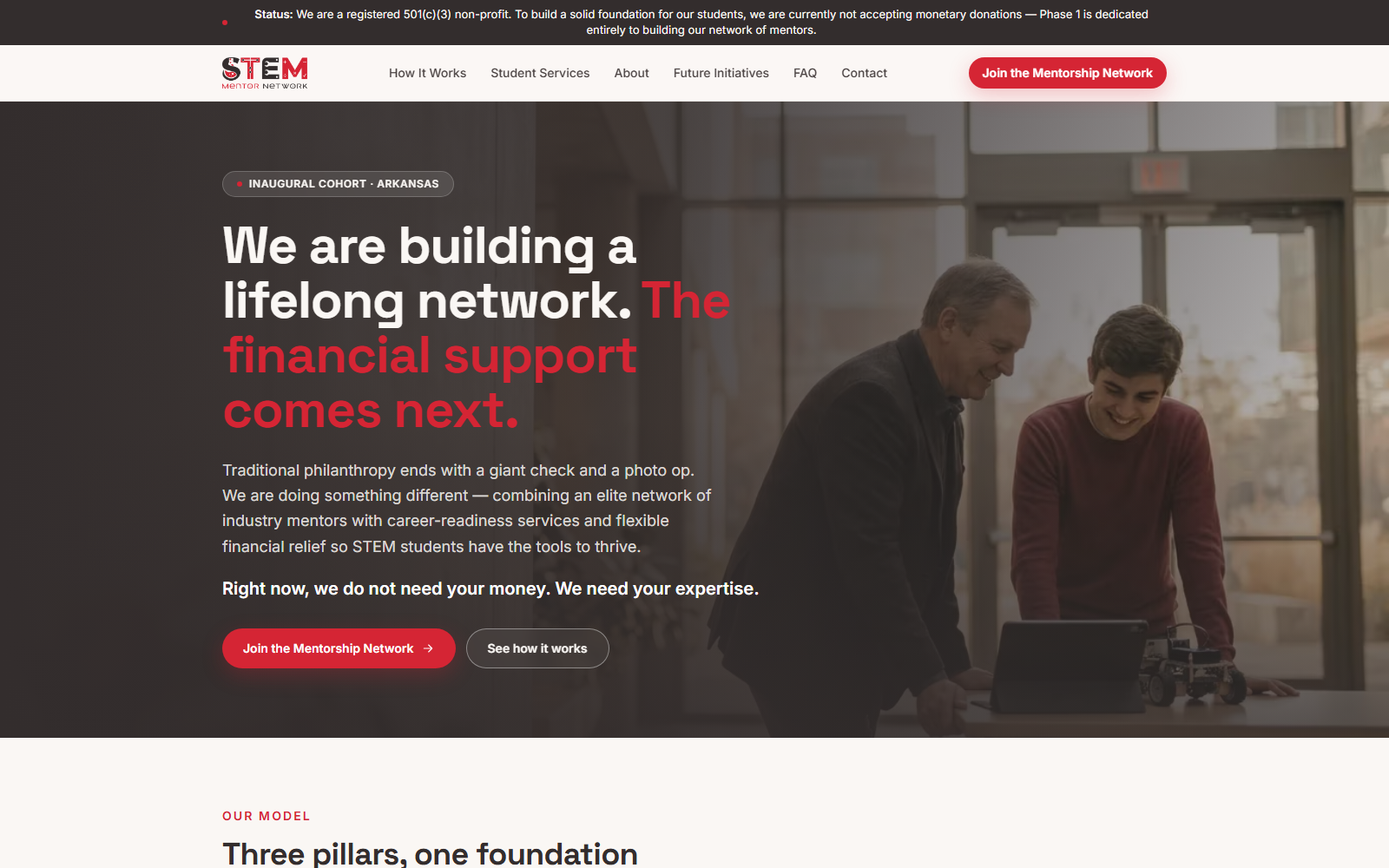
STEM Mentor Network is a Jonesboro 501(c)(3) pairing undergraduate STEM students with professional mentors on a pay-it-forward model, where each cohort mentors the next. Its primary ask is not a donation. It is a working professional agreeing to give time, and a student agreeing to be matched. The site leads with joining the mentor network and with the inaugural Arkansas cohort, which is the two-audience problem in its clearest form: two very different readers, one site, and neither of them there to buy anything.
STEM Mentor Network
STEM nonprofit · Jonesboro, AR
Frequently asked questions
How do we know whether we qualify for the Google Ad Grant? +
Our board will ask why we are paying for this instead of asking a volunteer. +
Our funding is mostly restricted. Does that rule this out? +
We need volunteers more than donors right now. Does that change the work? +
Do we have to worry about website accessibility? +
Start with the grant you may already qualify for.
Eligibility for the Google Ad Grant is a paperwork question before it is a marketing one, and it is better settled before you spend anything of your own. Grants that were awarded and then left alone are the other half of this: an account can stop serving without anyone at the organization hearing about it.