For powersports & equipment dealers
Growth marketing for powersports & equipment dealers.
Every location, every brand line, one system for turning searches into showroom visits — built around how people actually shop for a UTV, a Segway, or a zero-turn mower.
What makes dealer marketing different
Inventory turns over faster than the website does
Units sell, trade-ins come in, model years change — and a slow CMS or an OEM-provided template can't keep up. Shoppers land on stale inventory pages and bounce to a competitor who's current.
Multiple locations, multiple brands, one storefront
A dealer carrying Segway, Can-Am, Kawasaki, or a separate mower line across more than one storefront needs each brand and each address to show up correctly in search and on the map — not get flattened into one generic page.
AI answers are starting to skip the dealer entirely
Shoppers are asking AI tools which dealer carries a model, has it in stock, or offers financing nearby — and if your site isn't structured for those answers, the AI recommends whoever is.
Co-op rules limit what corporate marketing can do locally
OEM brand and co-op guidelines govern what can run under a manufacturer's name, but they don't cover the local map presence, the multi-brand comparison content, or the "near me" and financing searches that actually drive foot traffic to a specific store.
What we do
What we do for dealers
Six services, built around how powersports and equipment shoppers actually search, compare, and buy.
A fast website with real, browsable inventory
A custom-built site — not a stock OEM template — with inventory shoppers can actually filter and browse by brand, model, and location, plus quote and test-ride request forms that route to the right store.
AI Search Optimization
Units, trims, prices, and store availability published as text a machine can read, instead of locked inside a template built only for human eyes. The goal is to be the dealer named when a shopper puts that question to an assistant rather than to a search box.
Local SEO & map visibility, location by location
Each store gets its own accurate presence on Google Maps and in local search — hours, inventory, financing, and service info kept current so a shopper searching your area finds the right location, not a competitor two towns over.
Paid Search for models, "near me," and financing intent
Google Ads built around the searches that actually convert — specific model names, "near me" queries, and financing terms — tuned by location and brand line so co-op dollars and your own budget go toward buyers close to closing.
Paid social ads for inventory and seasonal demand
Inventory and seasonal-promotion ads run to a local radius around each store — mowers ahead of spring, UTVs ahead of hunting season — timed to how demand actually moves through the year. (We run paid social ads; we don't manage organic social posting.)
Conversion & analytics, tied to showroom visits
Lead and call tracking by location and campaign, so you can see which ads, pages, and keywords actually put people in front of a salesperson — not just which ones generated a click.
Proof
Built for a real multi-location, multi-brand dealer
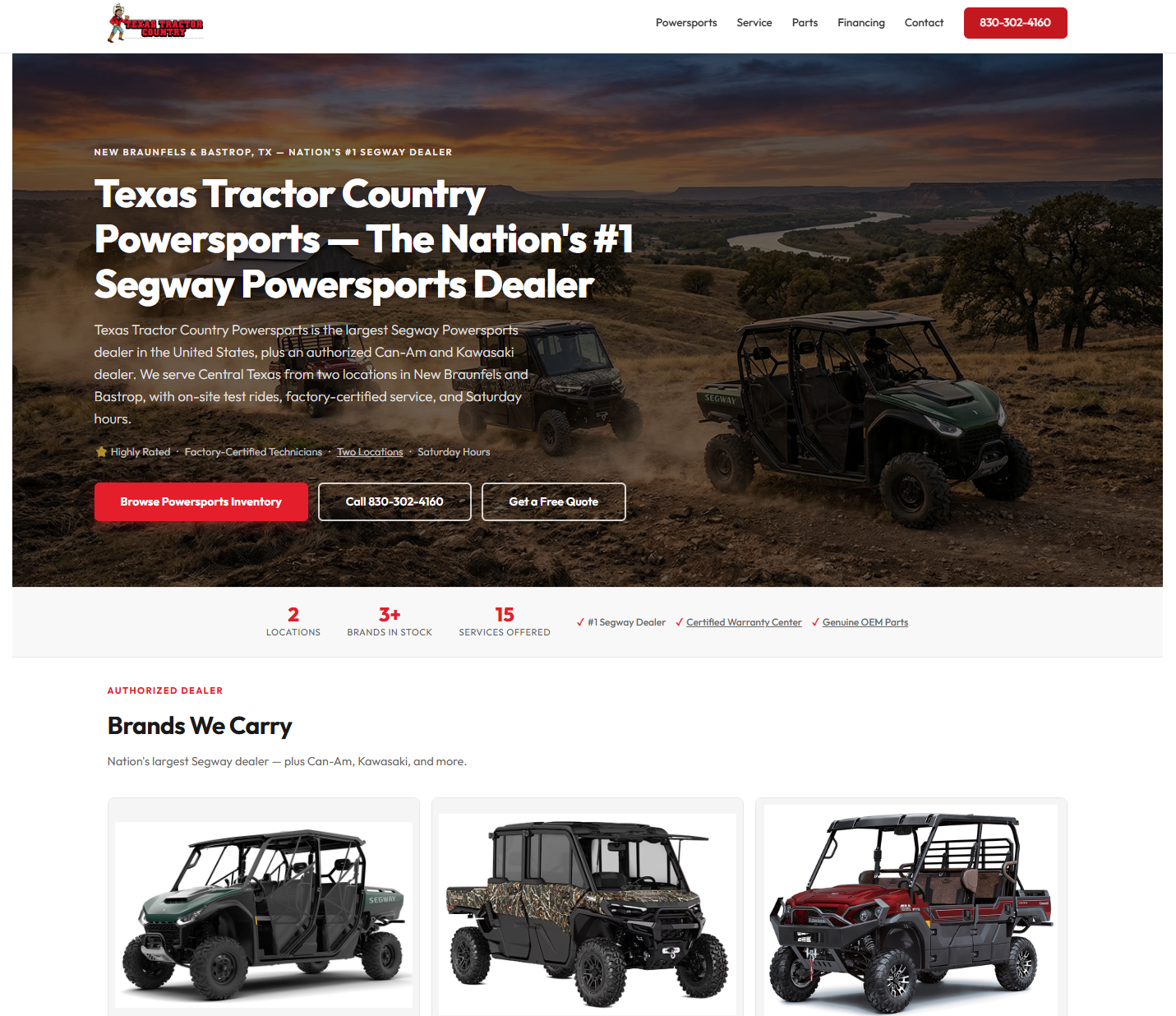
Texas Tractor Country is the nation's #1 Segway Powersports dealer, also carrying Can-Am and Kawasaki, plus a separate mower division selling Scag, Bad Boy, Spartan, and Hustler — all across two Central Texas locations. That's the exact problem this page is about: multiple brands, multiple storefronts, and shoppers who need to find the right inventory at the right address. We built their site around browsable inventory, financing, trade-in appraisals, and test-ride scheduling for both the powersports and mowers sides of the business.
Texas Tractor Country Powersports
Powersports · Multi-location dealer
Frequently asked questions
We carry multiple brands across multiple locations. Can one website handle all of that? +
Does this conflict with our OEM co-op or brand marketing rules? +
How do you handle seasonal demand — mowers in spring, UTVs in fall? +
Do you manage our social media posting? +
What does "AI Search Optimization" actually mean for a dealership? +
Ready to turn more searches into showroom visits?
Tell us about your locations and brand lines, and we'll show you where the gaps are.